This person's work is amazing in that it's done on garbage and using stencils and collage. Every time I look at his stuff it blows my mind. Simple and effective.
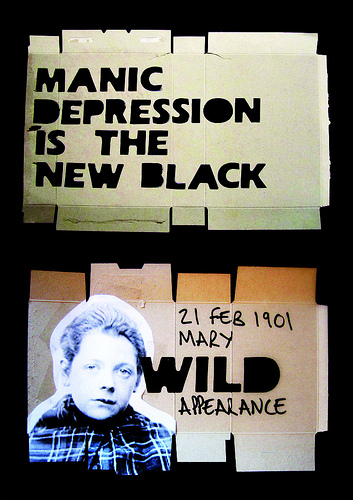
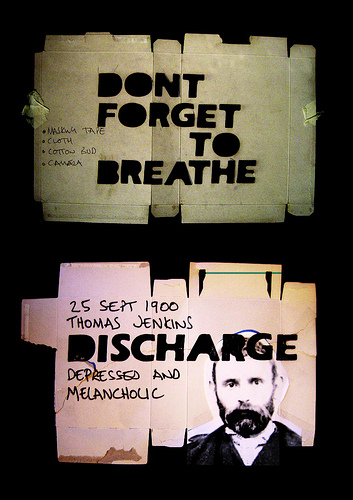
This person's work is amazing in that it's done on garbage and using stencils and collage. Every time I look at his stuff it blows my mind. Simple and effective.
Whoa. The cult of stuff discussion has taken off. On twitter and blogs (this needs a whole post) and other sites.
If you write on twitter about it include the hash tag #cultofstuff so we all can read your thoughts.
Most interesting to me is the discussion from this UK scrapper’s site. Mostly because these people don’t know me and I can safely assume that they have never ventured onto my blog. It gives me some insight into my tone.
It pains me to think that anyone would assume that I would sneer at their art journal. Nothing could be further from the truth. When someone decides to art journal they are stepping into a path of knowing, learning, exploring and experimenting. Sometimes art journaling comes along organically as people want more from their supplies and to see more results.
We shouldn’t take views centric to our particular art and craft as to a path to art journaling. I know people who have come to it from scrapping, others from fine art, others from writing, still more from the altered book realm and I’m sure that there are others who simply discovered art journaling.
We cannot assume that everyone comes to art journaling with the same experiences and tools that we each have. That is what makes art journaling so wonderfully individual.
And that is to say, even if you use mass produced tapes, papers, punches, masks, stencils, stamps and other things. no other person creates with your personal vision, set of experiences, and feelings. It’s still art, and your art.
But I want more. I want more of ME in that page. I want it to reverberate with what I’m feeling at that moment. If it’s a TH tape (that doesn’t stick) then that is what it is.
What I’m railing against here is the mentality that using mass produced stuff like TH’s wonderfully coordinated products and following the exact instructions that are posted to his blog, YT and where ever else. My feeling is that if you reproduce some one’s craft project step by step you are learning. That is great, but what next? Where do you go from making TH’s 12 tags of Christmas. You learned a lot of techniques. Do you take the next step and plunge into applying those techniques to your own work?
My point, and perhaps I’m a tad muddled here, is not that people are copying work but they are taking the easy way out. the companies make this even easier by making you really easy to use products and giving you step by step instructions. Insert tab D into slot C and suddenly you’ve got an art journal. Some might say that following someone else’s instructions is not art, I am not one of those people.
Art journaling is a path to self realization and taking the easy way out isn’t beneficial, it’s superficial. There are no rules to art journaling except that there are no rules.
I was emailing with one of my art friends and she said, “It’s as if people think that if it’s pretty everything will be okay.” I think it’s why many stick to the mass produced ephemera, stamps, and cookie cutter looks. It’s easy to make a pretty page when someone hands you instructions on how to do it. Use this color, use that color. Blend this colored pencil on this premade face. Stick this rubber stamp onto your page exactly 2.5 inches from the top edge and 3 inches from the right. And before long you don’t feel like you can do what you want, you are stuck in this pit of rules.
And here I say, screw the rules. Eff ‘em. Throw the rules out.
Take the rules you learned in that class about those faces and tip them on their side. Draw an oval and fill it with green and blues and all the colors YOU like. Those rules for blending? Follow those, but with the colors you love. Don’t worry about making it look just like so and so’s pretty girl. Make her yours. Give her purple eyes and red hair. Blend in some blue. Don’t think that you have to have the very same prismacolor.
You OWN that art journal, and that face, damn it, it’s yours.
Experiment on a few faces to create a look that is all yours. Fill a page up in your art journal to create your look, pick and chose colors you love. Go on, draw a variety of ovals, add some eyes, and a mouth you like.
You can do this.
Not because I say so, but because you KNOW you can and you WANT to.
When I was a kid I was pretty lucky to have parents that set very few limits for me. I was never told I couldn’t play in the woods (except when I cut down the neighbor’s tree, then Dad took my hatchet away for a week) or that I couldn’t go fishing on Saturday afternoons, as long as I told my parents, I was allowed to do it. There were rules but few limits. I never thought I couldn’t do things, and still I rarely stop to think that something isn’t possible, I do it. If I fail, well, I fail and I’m usually out a few dollars but I look to the experience as important as succeeding.
And that is the spirit I take to my art journal. I do it and think of the consequences later. I don’t think in terms of a ruined page, I think in terms of the experience of that page. I walk away and think, “Shoot, I won’t do that again.”
Don’t be afraid. It’s an art journal, it won’t bite. No one will see it unless you invite them to. You can close the book if you don’t like what its saying. You can change it. I’m a fan of leaving my ugly pages as they are, wart and all.
Remember to love your ugly pages too.
I deeply love my ugly pages. They teach me more about myself than the pretty pages. In the depths of layers glued in and painted on are deep thoughtful meditative moments. Moments when I’m so aware of who I am that it can be scary. I think that is what bugs us about ugly pages. Not that they are ugly but we’re afraid that we are reflected in them.
I’m not ashamed to admit that sometimes when I art journal the meditative moment can and does move me to tears. When I’m writing about deep painful things it’s not comfortable, but my art journal is about stretching me and opening my eyes to what I can be not just what I am. Sometimes when I’m brought ot that new level of who I am, that deep realization, I realize that I can be more.
Your art journal is your place to let that go. Glue in and paint down your fear. Meditate as you scrape paint over the pages, roughly gesso them, and gently massage a new piece of you into place. Your art journal doesn’t judge you, you judge you.
If you are new here, this is your first visit, please realize this is a (so far) 4 post rant on stuff. Feel free to head here to read the rest of my tirade. Also, please don't assume that I hate pretty pages or would sneer at your art. This rant is about empowerment not judgement.
I don’t want you to come away from these rants thinking I hate scrapbooking and all their supplies. In fact I used to say, often, “Man, I wish art journaling had some cool stuff like that. Why can't they make cool stuff I like?” And then everyone burst onto the scene with all kinds of cool stuff. Brads with tops shaped like screws, both phillips and flat? Check. Scissors to cut paper edges to look like postage? Check. Anyone remember the days of running your paper through a sewing machine to get that postage stamp edge? I sure do. Anyone else buy a junk clock at a thrift store and smash it to get at the gears? Me too! Now you can buy a baggie of gears that are identical to every other bag of gears on the shelf for $5. You can also buy a coordinating, mask, stencil and rubber stamp set. (As well as some good looking Tim Holtz tape, but it doesn’t stick.)
Back when I started out the only way to get a gear rubber stamp was to carve one. Rubberstamping companies didn’t want to make them, now they do, and they sell. Go figure. I still like my hand carved stamps better.
I’m not suggesting that things were better way back when I started out, what I’m suggesting is that we’ve got WAY more tools at our disposal. To the point we get lost in them. I see a lot of stuff out there where people are using the tools exactly as the manufacturer intended. They lay out a set of rules and everyone follows them. What I’m suggesting is this: Break the rules. Look at the “manufacturers suggested uses.” Then do one thing not suggested with that product. Try something they tell you NOT to do. Obviously nothing unsafe, but you get what I mean, if it says don’t mix with water, do it. If it says not for use on plastic, put it all over something plastic and then press a sheet of paper onto it. Try some things the manufacturer doesn’t suggest. Ask yourself, “WHAT IF.” Over and over and over again. If it doesn’t work you can always flip the page, gesso over it, or write about the problem and figure out a way to make it not happen again, or if it’s a really happy accident make it happen again.
When buying a new product the first question you should ask yourself as an artist and craftsperson is: “How can I make this do what I want it to do?” Then you should set about making it do what you want. If you can’t make it do what you want, consider a different product.
Do you know how hard it was to find a bone folder in 1998? I remember looking all over for one, and finally found one on a dusty back shelf at the Charrette Super Store (sadly now closed). Until I found that bone folder I used 2 glued together hardwood popsicle sticks that I sanded smooth. I made do with what I had access to and improvised until I could afford and find what I needed. Sometimes you gotta do what you gotta do.
Back in high school I signed up for chemistry class. The guy teaching it clearly loved the subject and was brand new to the school. Well, the teacher who had been there for a long time had cherry picked the best students. So Mr. NewGuy got everyone else, including me. I think getting a class full of the “rejects” kinda bummed him out. He ran his class differently, I don’t want to call it a free-for-all but it was. In the end I did better in that class than my classmates in the more structured class. I expect it was because I was allowed and encouraged to ask, “What if” a lot. That class (as well as growing up on a farm with both my parents being teachers) really instilled in me the importance of asking, “What if…” and they trying it.
One of the things I’d like to really suggest to you is that everything you put into your art journal doesn’t need to be acid free or archival.
Whoaaaaa.
Yeah I went there.
I load my journals up with all sorts of stuff that isn’t archival- tea bags, boxes from gum, cigarette boxes that blow into my yard, shopping lists I find, packaging I like, and the list could go on.
Am I worried about the stuff rotting and falling apart? Nope.
It’s my sketchbook. It’s meant to be an on going work that I refer to for inspiration.
In college a few of my professors were all about us using acid free and archival materials, suggesting to us that we should work with what we would if we were professionals. This led to a lot of us buying extremely expensive materials and perhaps a bloated sense of self importance about our student work. I’m not saying that student work isn’t good; it’s just not as evolved as what one makes later in life. Fast forward to when I’ve graduated from college and I’m a teacher, we manage to snag Richard Lee to come in and speak to the class and lead a 2 day long papermaking workshop. I absorbed as much info as the students did, if not more. For part of the workshop Richard brought in his sketchbooks. He’d traveled the world and took amazing notes about papermaking and made the most amazing drawings- with a sharpie and colored in with a small traveling watercolor box. His sketchbook were simply amazing. They blew my mind. The covers were cast paper and the inside handmade papers.
One of my first questions for him was, “Sharpie? Are you worried about them being acidic?” He kinda looked at me like I had 3 heads and said, “Nope. I like extra fine sharpies, they dry fast and they are cheap and I don't worry if I lose 'em.”
I pestered him with questions as did the kids until he was bored and we made paper and then books. In that one moment he totally put on end what my professors had been telling me I needed to do and should do for 4 years. Here’s a guy who was a working artist telling me he liked a material because it was cheap and dried fast. It blew my fragile little mind.
My point being, we should be more concerned with making art and less concerned with what it’s made with. Use what you like and as Picasso said, “the archivists will have a job.” Or something to that effect.
I have a whole long tirade about who acid free and archival are really just marketing tools at this point and how really most of that archival stuff you buy at the craft store isn’t really archival unless it’s got the following standard on it somewhere: ISO 11108. There isn’t any regulation to manufacturers slapping the word archival on their product. Also acid free doesn’t mean archival. It means it’s got a ph higher than 7. Another fun factoid, most of the paper produced in the US (or for the US market) is acid free because it plays better with printing inks. You can buy a little pen to test the acid content of your papers; it’s not really worth it though. The more you handle your paper and the more it gets exposed to air the more acidic it gets, eventually it will be acidic. It might take 10, 20, 30 or 50 years but it will show a higher ph level over time. I could really go on and on about this, but my mantra remains, buy the best you can afford, upgrade later. If like Richard you like sharpies go ahead and use them.
If you are new here, this is your first visit, please realize this is a (so far) 4 post rant on stuff. Feel free to head here to read the rest of my tirade. Also, please don't assume that I hate pretty pages or would sneer at your art. This rant is about empowerment not judgement.