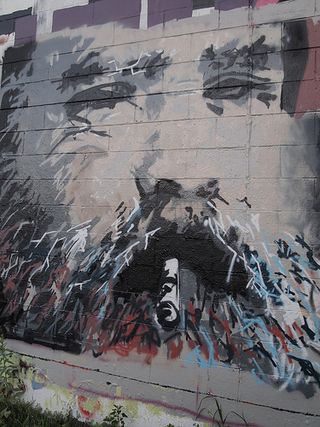
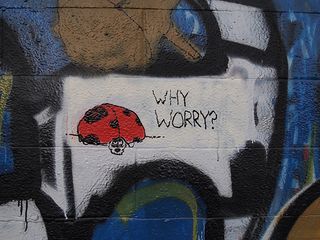
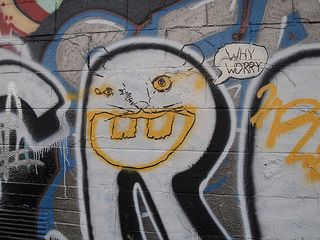
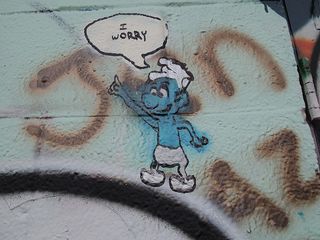
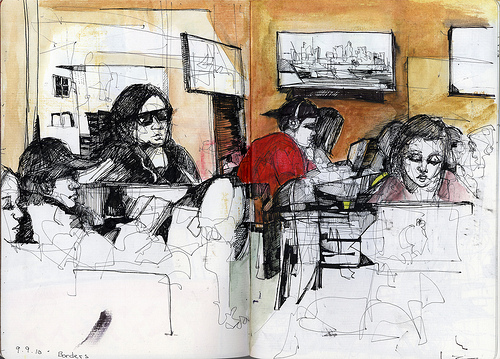
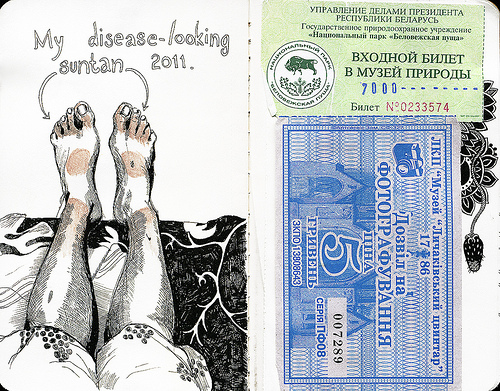
I'm particularly in love with this image by LaWendula working in Wreck this Journal:
It emphasises why I really enjoy Wreck this Journal though I've never worked through it myself. WtJ harmonizes with my style of art journaling perfectly.
I'm particularly in love with this image by LaWendula working in Wreck this Journal:
It emphasises why I really enjoy Wreck this Journal though I've never worked through it myself. WtJ harmonizes with my style of art journaling perfectly.
I'm obsessed with making watercolor tins. I've been looking for more and more adaptable methods since I made my first with medication blister packs. (I have a UStream about this.)
On my way home a few nights ago I had the brainstorm to try to make the pans out of moldable epoxy putty, like that Mighty Putty stuff. I have a bunch of tubes of that but can't find them so I stopped by Ocean State Job lot to look into their glue section. (They generally have a ton of weird glues.) If I hadn't found it I'd have headed to Home Depot. I found a tube of Elmer's Automotive Epoxy putty. You could also use Mighty Putty, Sugru, or JB Weld's Putty.
The key to this project is that you get MOLDABLE epoxy putty. The Elmer's has a working or open time of 2 minutes after it's fully kneaded together, which works for this project.
You cut a chunk off, knead it until it's fully mixed, roll a snake and then press it into place in your tin and then mold it into a wall. Keeping your hands damp through the process helped a lot.
Once the walls firm up you can trim them with a knife. I used a utility knife to trim the walls into a nice straight surface, well mostly. Partially hardened the putty carves pretty easily.
After I built all the walls I let it cure and then sprayed it with a kind of even coat of white spray paint. I also sprayed the outside with a little gray spray paint.
This little adventure cost me the $2.50 for the gum and $2.99 for the epoxy putty. If I were chewing the gum anyway (which I do) it's sort of an even sum thing. If you have a friend who chews gum or is a mint addict this could be even cheaper. I used approximately 1/3rd of the putty. A larger tin like an altoids tin would use more and a mini altoids tin less.
I made myself 6 areas for paint and a small mixing area. The wells are 3/4 a full pan of a half pan and a half (this will only make sense to people who have half pan watercolor sets.) Anyway pictures:
Awhile back I purchased a planner* from gouletpens.com and I didn’t do anything with it. I snagged it for about $4 off their clearance rack because it was for the 2010 and 2011 school year. The pages while tough enough for a lot of use for I was planning I felt needed a little heavy duty treatment, so I started gluing pages together, every other page. This gave me a very heavy weight page.
I then applied a coat of gesso and watercolor crayon to each left hand page. I used a soft brush to really blend the colors into the gesso. Each page has a soft tint of the watercolor crayon. I then used tape that I’d masked off painting (it's got random colors all over it) with to cover up dates and calendars on the right hand page, leaving me with a nice framed grid on the right hand page.
I cut no pages from the planner. I know it’s strange but I really like that stressed out thick spine look. I also plan on adding a lot of collage to the left page. The right page may get some collage but I plan on mainly writing on it.
The other thing about this journal? I’m drawing in it with sharpies and nothing else. It’s the reason I wanted to glue pages and gesso them, so that I wouldn’t get soak through.
So far the journal is a combination of collage, sketch and writing. I always work in spreads so this journal is really working well for that.
Here’s what a spread in the book looks like with no sketching, collage or writing.
And here are a few finished pages:
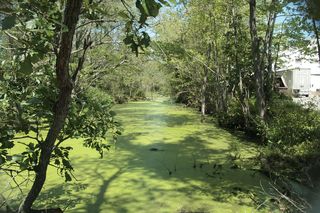
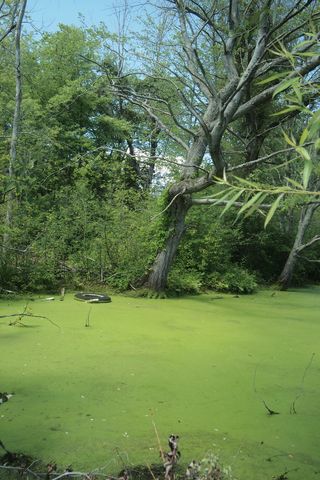
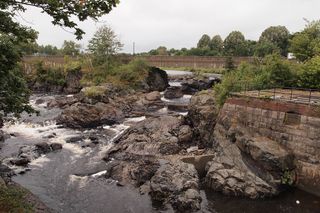
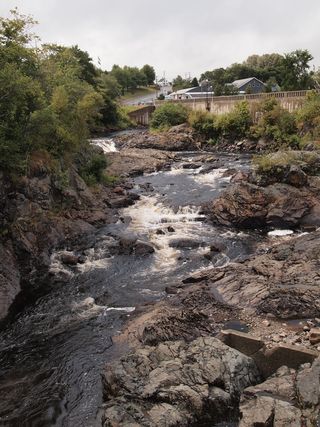
Yesterday I went to Saugus Iron Works with my good friend Jane for painting, photographing and sketching time. It was great. The day was hot and the scenery was great and I drank 40 ounces of water. Thankfully, I wore sun block, by the end of the day, Jane’s iPhone was giving off temperature warnings! Yikes!
When I first got there I wandered around snapping pictures for a good 30 minutes or so. One of the Rangers spotted me with my camera and we chatted for a few minutes and he asked me if I wanted to see the water wheel working, of course I did, so he got another Ranger and they opened up the water and I got to see the water wheel working. It was pretty cool. It was especially amazing to see that almost everything there was built of wood or stone. Meaning they worked the iron with a lot of wood, crazy stuff.
I saw lots of great stuff. Big ass wooden gears? Hell yes! Big white Great Egrets? Yup. A blast furnace with bellows that stand 10 feet high? Mhmm.
It was funny that I would sit down and paint a picture of the river leading away from the buildings but I enjoyed that scene as well. I’ll post a scan of the paintings I did as well as some of the sketches from that day.
All in all, Jane and I both agreed that this was a sight we’d be returning for many more sessions of drawing and sketching. If you are looking for a free thing to do with kids in a quiet spot not too far from civilization Saugus Iron Works is it.
I am seemingly one of the few artists (journalers) who is not in love with Julia Cameron’s The Artist’s Way. Don’t get me wrong, I’ve read it, I’ve got it on my bookshelf, complete with the bookmark exactly where I left off. Sometimes I feel like I’m the only one who isn’t telling everyone else what a great book this is, recommending it every time someone I know hits a block.
It’s not that I don’t get it or that I don’t think it’s a wonderful book, it simply didn’t resonate with me. Sometimes I feel guilty that I’m just not that into TAW. Someone once told me that to follow TAW was a commitment, and I have to agree. There are groups online to help you get into TAW as well as a workbook, and at some community colleges you can take a course in TAW.
Reading TAW or taking a course in TAW can be a transfomative experience for some people, at the end of the line, the real message behind TAW (and all it’s look alikes) is that you need to spend time making and thinking about art.
If you think this might be a good book, pick it up. Maybe I'll revisit it, or not.
I was the sort of art student who loved the “outsider” art tacked to the walls in the basement of the official art shows in college. It was raw and rough. I liked the look.
There came a time when I grew up and I realized that even some of the most rough and rugged art looks great or even better when framed. It’s true. A frame sets art off from the wall, enshrines it and best of all emphasizes it.
Case in point, take a look at this image I painted of a sunset. It’s a small 5×7 inch painting. Alone on the wall it looks lost, even with the clean taped edge.
Stick that same image in a mat and wow, it looks so much better. As much as my 19 year old self would grumble at the added expense, this DOES look better, even in JUST the mat. Now imagine if I framed that image?
A friend of mine calls this effort, I call it extra work and added expense. But I’ve come to realize that IF I want to sell my art I have to appeal at least in part, to the buyers of art, not to my inner 19 year old rebel. Part of that appeal is handling my art in a professional manner- matting it up and placing it in a Krystal Seal bag or framing it when necessary.
I really do think that it looks a lot better when matted and those Krystalphane bags really do a great job of snazzing them up, giving you a good idea of what the piece will look like under glass.
Plus take a look at the prices on the mat and Krystal Seal bags I linked, those are pretty cheap.
I’ve forgotten where I learned this technique but I know atleast one of my professors from college used this for the first few layers when prepping his boards and canvases for painting.
And that is to use this:
(Imagine there is a picture of a small foam paint roller here, ama zon is being a dink and won't let me link it up.)
To roll on the first several layers of gesso.
I’m using a heavy foam roller, 4 inches wide by about 1 inch in diameter. It lays down a even coat of gesso, in the exact same texture as when applying wall paint, a pebbled texture that looks like an eggshell. The thicker the gesso the higher the peaks.
The one down side is that the roller holds a lot of gesso, so it’s best to plan ahead and cover a lot of paper or canvas when you are rolling gesso. It’s also effective to get a perfect smooth surface with much less work than using a brush. (Another downside is that if you are rolling the roller away from you it will kick up a lot of fine even splatters, it will coat a new black shirt in sand like dabs of paint. This may or maynot have occured in real life.)
I used the roller as if I were rolling ink onto a plate. Then rolled it onto the paper or board as if I was painting a wall. I allowed it to dry between coats and I did not sand at all, I enjoy the texture.
I’m at that point in a painting where I want to dump a gallon of black gesso onto its surface and start all over.
Here’s the thing, I go through that with every painting. It’s a given that I hit a stage where I just hate it, hate the colors, hate the texture, hate how rough it is, and think it’s never going to get to a point where I’m happy with it.
Then I push through it, add another layer of paint, maybe some glaze, more white here, a little green here, maybe a little yellow, and soon enough it shapes up to be closer to where I want, and then a little closer until I’m happy with it.
The problem starts when I don’t push through that barrier. If I let it go and stop working then I lose momentum and soon enough I’m staring at that crappy unfinished painting on the easel that lack clarity and mojo.
I’ll press on but I need a break from the painting but tomorrow I’ll be back at it.
One of the many jobs I've had is as a floral designer and florist. Pretty shocking isn't it? I've had said of me, "you are the least likely florist" "not the person I'd go to for flowers but you do a damn good job" "when I saw you I didn't think you'd do a good job, but these are awesome." Me being a florist is slightly ridiculous but I have always enjoyed flowers since I was a small child. My father was an avid gardener, in spring he'd dig up pieces of his day lilies and narcicus, toss them in the back of his work truck with a shovel and when he'd read the meters at homes with neat flowers, knock on the door and offer a trade. He was younger at teh time, and I'm sure his smile coupled with whatever line he used got him the trades he was interested in.
Funny thing is, people with gardens like to trade for things they don't have already, using my father's model of digging up pieces of flowers I've traded with other people. I also like to give chunks of my plants as gifts.
My pink day lilies are unusual and most people love them. Anyway, I went to the Lynch Park gardens and snapped a few shots. These are straight out of hte camera, which will take square pictures. The garden does NOT have it's plants labeled which drives me nuts, I'd at least like to know the common names of the varities.
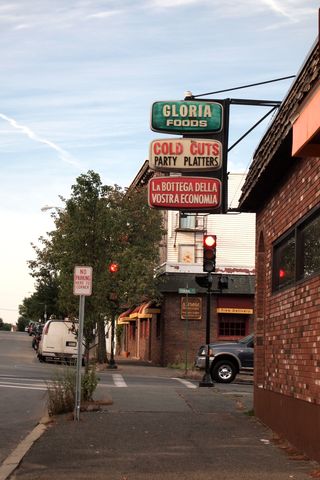
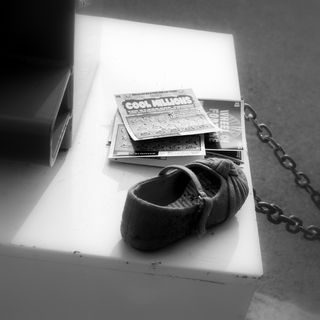
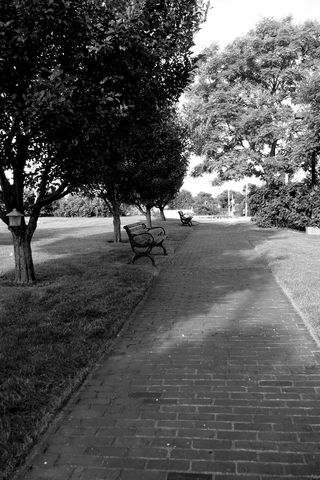
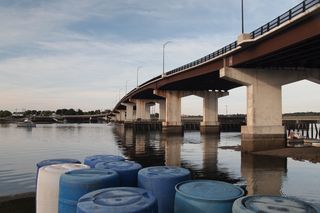
I'm being a terrible blogger these last couple of days. Just know it's for good reasons, m'kay? So here are some pictures I took over the last week or so. 
These are PINK day lilies. I never thought I'd be a fan of them but these kick ass, and people like to trade other day lilies for them. This is a nice sunset shot of one.

Apparently my city has a couple of "working" docks and not just docks for fancy boats. In this case, a lobster boat is at the dock.

*SIGH* Teenagers and Jager go hand in hand, sadly the drunk teens leave "stuff" behind. This will make some great sea glass later- dark gree is great. (I also found some err used "protection" in the beach trash. Seriously people, dispose of it in better ways!)
Another shot of the lobster boat. This may become a painting later this winter, or not, who knows.
Taht being said, I'm getting to know the camera better and I'm thinking more about the shots themselves, not just pointing and shooting. I'm better at composing a scene just by looking than I am through the lens, I guess years of en plein air painting has some positive effect. I've figuring out how to start teh pricocess of applying how I look when I'm painting to the lens of my camera. It's not that different, it seems to be about looking around, like i do when I'm painting and then holding up the camera and clicking.